Wildcat Off-Road Park Beginner Guide: What New Riders Should Know
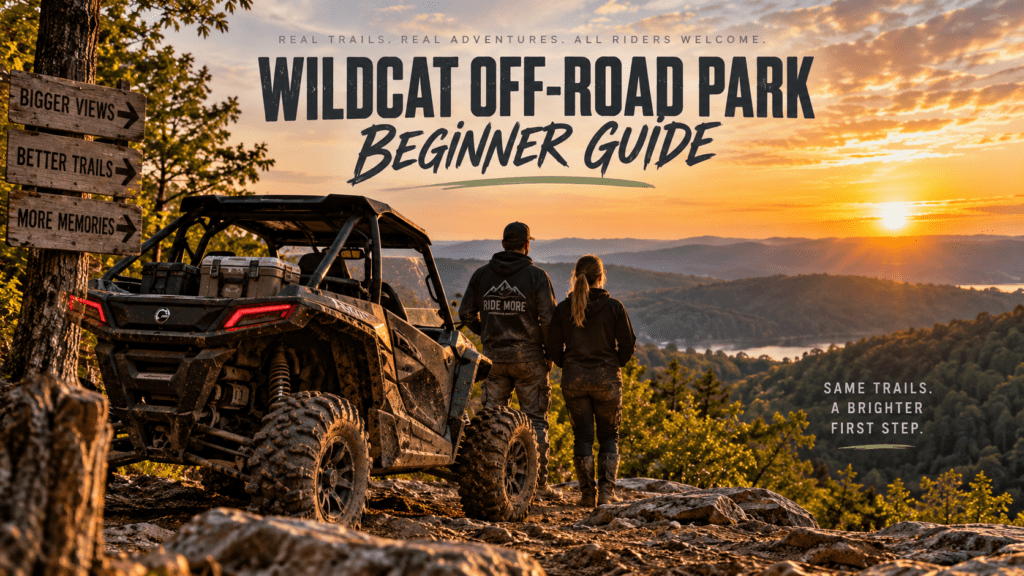
If you’re looking at photos and videos of Wildcat Off-Road Park and wondering “Can a beginner actually ride there?”, the short answer is:
Yes—but your first Wildcat ride should be about choosing the right terrain, not proving what your machine can do.
Wildcat Off-Road Park in East Bernstadt, Kentucky, covers approximately 2,000 acres with more than 140 miles of trails. That amount of terrain means your experience can vary considerably depending on where you ride, current conditions and who you’re riding with.
You don’t have to spend your first Wildcat trip attacking the hardest hills, deepest mud or most technical obstacles you can find.
A successful beginner trip is one where you gradually learn the terrain, understand what you and your machine are comfortable with, and finish the weekend thinking:
“I can’t wait to come back.”
This guide will help you do exactly that.
Is Wildcat Off-Road Park Good for Beginners?
Wildcat can be an excellent place for newer riders, provided you approach it correctly.
The important thing to understand is that Wildcat isn’t one trail.
You’re dealing with a large trail system where terrain and conditions can vary. That means a video showing somebody tackling a difficult obstacle doesn’t represent everything you’ll encounter at Wildcat.
Don’t judge whether you belong there based on the wildest Facebook or YouTube video you find.
Experienced riders naturally tend to record the dramatic stuff.
Nobody gets nearly as excited about uploading a 10-minute video titled “We drove around comfortably and nothing went wrong.”
But that’s often exactly what a beginner needs.
Your objective isn’t to conquer Wildcat on your first weekend.
It’s to learn it.
Your Machine Is Probably More Capable Than You Think
New UTV and SxS owners sometimes assume they need major modifications before visiting an off-road park.
For ordinary recreational riding, that’s often unnecessary.
A mechanically sound stock machine can provide an enormous amount of fun.
Before worrying about upgrades, learn what you already have.
Know how to engage four-wheel drive.
If your machine has selectable drive modes, understand what they do.
Know how your parking brake works on an incline.
Know where your recovery points are.
If you have a winch, learn how to operate it before you’re stuck.
Understand your ground clearance.
Know roughly where your tires are relative to the driver’s seat.
Those skills will probably help a beginner more than another accessory bolted onto the machine.
The Best Beginner Modification Is Seat Time
It’s easy to believe another modification will make you ready.
Bigger tires.
More ground clearance.
Suspension upgrades.
A tune.
More horsepower.
Some upgrades absolutely improve a machine, but none replace experience.
Beginners benefit enormously from simply learning how their machine reacts.
Practice smooth throttle control.
Learn how much steering input it needs.
Feel what happens when one tire climbs over an obstacle.
Learn how the machine behaves going uphill and downhill.
Get comfortable judging its width.
The more predictable the machine feels, the less mental energy you’ll spend controlling it—and the more attention you can give to the trail ahead.
Start Easier Than You Think You Need To
This is probably the single best piece of advice for a new Wildcat rider.
Make the first part of the day easy.
You can always increase the difficulty later.
Starting conservatively gives you time to learn the surface, understand current conditions and settle into the machine.
It also gives your group an opportunity to identify problems early.
Maybe someone’s tire pressure is wrong.
Maybe something wasn’t secured properly.
Maybe one rider is considerably less comfortable than expected.
Maybe recent rain has changed conditions.
Discover those things on manageable terrain—not halfway through something difficult.
There’s almost no downside to beginning easier than necessary.
There can be a considerable downside to beginning too hard.
Learn to Read the Trail Ahead
One of the biggest differences between an experienced rider and a beginner isn’t bravery.
It’s how much information they extract from the terrain before reaching it.
Start looking farther ahead.
Where are the tires going to travel?
Is one side considerably higher than the other?
Is that dark area mud or simply wet dirt?
Is there a rock hidden behind the one you’re concentrating on?
What’s on the other side of the hill?
Where does the trail go after the obstacle?
Don’t stare exclusively at the thing you’re trying to avoid.
Your machine tends to follow where you’re looking.
As your experience grows, you’ll stop seeing one giant obstacle and start seeing possible lines through it.
That’s a major step in becoming a better trail rider.
What Is a “Line”?
You’ll hear experienced off-road riders talk about choosing a line.
Your line is simply the path you intend your tires to take through an obstacle or difficult section.
Sometimes moving six inches left or right can dramatically change the difficulty.
One line may put your tire on top of a rock.
Another may put the differential directly over it.
One line may keep the machine relatively level.
Another may put you significantly off-camber.
Beginners frequently watch the center of the machine.
Try thinking about all four tires instead.
Where do you want each one to go?
You don’t need to become an expert spotter overnight.
Just start thinking deliberately about tire placement.
Stop Before an Obstacle You Don’t Understand
There is no rule saying you must hit an obstacle at the same speed you approached it.
If you’re unsure, stop somewhere safe and look at it.
Get out if necessary.
Walk the section.
Look at the other side.
Check the depth of a rut.
Look for rocks.
Watch another machine.
Ask a more experienced rider.
Determine whether there’s an easier line or bypass.
Thirty seconds of investigation can prevent hours of recovery or repair.
Experienced riders do this too.
Stopping doesn’t mean you’re afraid of the obstacle.
It means you’re making a decision with better information.
There Is Nothing Wrong With Turning Around
This deserves its own section because beginners sometimes feel pressure to continue once they’ve committed to a trail.
You don’t owe the trail anything.
If something doesn’t look right, stop.
If the weather changed, reconsider.
If the machine isn’t behaving normally, reconsider.
If you’re exhausted, reconsider.
If the obstacle is beyond your current comfort level, look for another option.
A good off-road decision isn’t the most aggressive decision.
It’s the decision that gets the machine and riders back in good condition.
You’ll have another opportunity.
Never Let Someone Shame You Into an Obstacle
This is particularly important for new riders.
An experienced rider saying “You’ll make it” can be useful information.
It isn’t an obligation.
They’re not sitting in your seat.
They may have more experience.
Their machine may be configured differently.
They may simply have a different tolerance for risk.
Listen to experienced people. Ask them why they think a particular line works. Learn from them.
But ultimately, the driver decides.
Good riding partners respect that.
Choose Your First Wildcat Group Carefully
Who you ride with can have more impact on your first experience than which trail you choose.
The ideal experienced rider for a beginner isn’t necessarily the person with the most capable machine.
It’s the person with patience.
You want someone willing to slow down, explain a line, wait at intersections and help without turning every obstacle into a competition.
If you’re the experienced rider bringing a beginner, remember:
You’re leading their ride, not yours.
If they finish the day confident and excited, you’ve probably created another lifelong rider.
If they spend eight hours terrified of holding everyone up, they may not want to come back.
Put the Beginner Near the Front
For group rides, don’t automatically put the least experienced person at the very back.
A beginner buried at the end of a long line can spend the day trying to keep up.
Instead, consider placing an experienced leader first and the newer rider relatively close behind.
That allows the beginner to watch how the lead machine approaches terrain.
The leader can also better control the pace.
Another experienced rider toward the rear can help make sure the entire group stays together.
The objective isn’t speed.
It’s keeping everyone connected.
Don’t Follow the Machine Ahead Too Closely
Watching an experienced driver can teach you a lot.
Following directly on their bumper doesn’t.
Leave enough distance to see the terrain for yourself.
The machine ahead may suddenly stop.
It may roll backward slightly on a hill.
It may throw rocks or mud.
It may reveal a hole you couldn’t see.
And you need room to choose your own line, rather than blindly following theirs.
Give yourself space to think.
Hills: Momentum Is Different From Speed
New riders sometimes approach hills with one of two strategies:
Too little throttle because they’re nervous.
Or way too much because someone yelled, “SEND IT!”
Neither is a universal solution.
Many climbs are about maintaining appropriate, controlled momentum while keeping the machine composed.
Avoid unnecessary abrupt steering on steep terrain.
Look where you’re going.
Understand what is beyond the crest before charging over it.
And if you’re uncertain about a climb, watch an experienced rider first.
Pay attention to where their tires go—not just how much throttle you hear.
Going Down Can Feel Harder Than Going Up
Beginners often worry about climbing hills and then discover descents make them more uncomfortable.
That’s normal.
The important thing is maintaining control.
Use your machine’s appropriate gearing and engine braking capabilities where applicable.
Avoid panicked inputs.
Keep the machine straight when possible.
Look ahead instead of directly over the hood.
Give the machine time to work.
And never start down something without considering what happens if you decide halfway through that you don’t like it.
Once gravity joins the ride, your options change quickly.
Off-Camber Terrain Feels Worse Than It Looks
Off-camber means the machine is tilted sideways because one side of the trail is higher than the other.
For beginners, this sensation can be extremely uncomfortable.
Your body notices the angle immediately.
The natural reaction is sometimes to steer abruptly downhill or make another sudden correction.
Don’t panic.
Reduce unnecessary speed, look ahead and make smooth inputs.
If the section appears beyond your comfort level, stop somewhere safe and evaluate it before proceeding.
This is another situation where watching an experienced rider’s tire placement can teach you a great deal.
Mud: Don’t Confuse More Throttle With More Skill
Mud is part of the fun for many Wildcat riders.
It’s also an excellent place for beginners to get stuck unnecessarily.
Before charging into a mud hole, ask yourself:
How deep is it?
Is there a visible bottom?
Where have other machines been traveling?
Is there a way around it?
What happens if I don’t make it?
Do we have recovery equipment?
Sometimes momentum helps.
Sometimes more throttle simply digs four holes faster.
You don’t have to enter every mud hole you encounter.
Water Crossings Deserve Extra Respect
Water hides information.
You may not be able to see the bottom.
You may not know the depth.
You may not see a submerged rock, hole or ledge.
And conditions can change after rainfall.
Current trail reporting in the Wildcat area illustrates the point: water crossings that riders navigate normally can become substantially deeper following rain.
Don’t assume a crossing is safe simply because someone drove through it last weekend—or because the machine ahead of you made it.
If you’re uncertain, evaluate it first.
Water doesn’t care how expensive your machine is.
Rain Can Change the Difficulty of Your Entire Day
A trail you found easy yesterday may not feel the same after significant rainfall.
Traction changes.
Mud develops.
Ruts hold water.
Creeks rise.
Rocks become slick.
Hill climbs change.
That’s why beginners should treat trail difficulty as dynamic, not permanent.
Check the weather before riding.
If it rained heavily overnight, don’t automatically repeat yesterday’s decisions based on yesterday’s conditions.
This is particularly important in Kentucky, where weather can quickly become part of the off-road experience.
Know When You’re Getting Tired
Fatigue sneaks up on new riders.
You’ve been steering, bracing, watching the terrain, making constant decisions and absorbing bumps for hours.
Eventually, your concentration declines.
That’s when easy mistakes happen.
You pick a bad line.
You stop paying attention to the machine ahead.
You use too much throttle.
You miss an intersection.
Take breaks before you desperately need them.
Drink water.
Eat something.
Get out of the machine.
Stretch.
A 15-minute break can make the next two hours considerably better.
A Beginner Doesn’t Need to Ride All Day
You paid for the trip.
That doesn’t mean you have to extract every possible minute from it.
If you’ve had six great hours and everybody is tired, returning to basecamp isn’t failure.
It’s often the smart move.
There’s a big psychological difference between ending a ride while everyone is still having fun and dragging it out until everyone is miserable.
Leave yourself wanting a little more.
That’s an excellent reason to return tomorrow.
What Beginners Should Carry
You don’t need to load your SxS like you’re crossing the continent.
But don’t ride completely unprepared either.
At minimum, think about personal safety gear, water, weather protection, communication, navigation and basic recovery capability.
What you need depends on your machine and the kind of riding you’re doing, so we’ve intentionally kept the detailed equipment discussion out of this article.
For the complete gear breakdown, read our What to Pack for a UTV Trip to Wildcat Off-Road Park guide.
Learn Basic Recovery Before You Need It
If you’re carrying a winch but nobody in the group knows how to use it safely, you don’t really have a recovery plan.
Before the trip, learn the basics of whatever recovery equipment you carry.
Know your machine’s proper recovery points.
Understand how your winch controls work.
Keep people clear of loaded recovery equipment.
Don’t improvise attachment points because you’re frustrated.
Beginners don’t need to become professional recovery experts.
They should simply understand that getting stuck is a normal part of off-roading—and getting unstuck should be handled deliberately.
Navigation Matters More Than Beginners Expect
When you’re new, trails can begin looking surprisingly similar.
Get the current Wildcat trail map.
Understand roughly where you’re starting.
If you use digital mapping, download what you need before relying on it in an area with inconsistent cellular service.
And make sure more than one person knows where the group is going.
For more about check-in, maps, current park hours and managing your first visit, read Your First Trip to Wildcat Off-Road Park: Everything You Need to Know Before You Go.
Your First Ride Doesn’t Need to Be Your Best Ride
You’re going to improve.
You’ll learn how your machine feels.
You’ll become better at choosing lines.
You’ll stop tensing up at every tilt.
You’ll recognize terrain faster.
You’ll learn when momentum helps and when patience helps.
Something that looks intimidating Saturday morning may look completely manageable Sunday afternoon.
That’s one of the best parts of learning to ride.
You can actually feel yourself getting better.
How Do You Know When You’re Ready for Harder Terrain?
Don’t measure readiness by whether you’re bored.
Look for confidence in the fundamentals.
Are you choosing your own lines?
Are you controlling the machine rather than reacting to it?
Are you looking ahead?
Can you handle hills without panicking?
Do you understand your machine’s dimensions?
Can you recognize when you should stop and investigate something?
Are you making deliberate decisions?
If yes, gradually increase the challenge.
Not from easy directly to extreme.
Just one step harder.
That’s how skill grows without destroying confidence.
What If Your Passenger Is the Beginner?
Drivers aren’t the only people who can be uncomfortable.
If you’re bringing a spouse, child, friend or family member who’s new to off-roading, communicate with them.
A driver may feel completely in control while the passenger feels like the machine is about to roll over.
Explain what’s happening.
Warn them before a significant obstacle.
Take breaks.
Ask whether they’re still having fun.
Don’t use fear as entertainment.
If their first off-road experience is enjoyable, they’ll probably want another one.
That’s a much better outcome than proving how capable your machine is.
Parents: Make the First Experience Fun
Wildcat markets itself as an off-road destination for enthusiasts and families.
If you’re introducing younger riders to the experience, resist the temptation to make the day about how much terrain you can cover.
Comfort, appropriate safety equipment, breaks, food, water and reasonable riding duration matter.
Kids don’t need the most extreme trail to remember the weekend.
They may remember splashing through water, eating lunch beside the machines, seeing a great view or sitting around the fire afterward.
You’re building their definition of what an off-road trip feels like.
Make it a good one.
After the Ride Matters Too
Beginners tend to focus almost entirely on the trail.
Experienced groups learn that a great riding weekend has two halves:
The ride—and the recovery.
After hours on the machine, you’re probably dirty, hungry and tired.
You need somewhere for wet boots.
Somewhere for helmets.
A shower.
Dry clothes.
Food.
A comfortable place to sit.
And eventually, a good night’s sleep.
That’s why we think of lodging around Wildcat as a basecamp, not simply somewhere to sleep.
If you’re comparing accommodations for your trip, our Where to Stay Near Wildcat Off-Road Park guide explains what riders should look for in trailer parking, real beds, bathrooms, laundry, kitchens, gear management and post-ride comfort.
Why Wildcat Backwoods Is Built Around Riders
Wildcat Backwoods came from looking at the entire riding weekend rather than just the bedroom.
At Wildcat Pondside Basecamp, we’re building around groups of up to eight riders with four real queen beds, two full bathrooms, two living spaces, a full kitchen, Speed Queen laundry, rider gear organization and substantial truck-and-trailer parking.
After the ride, there’s a pond, firepit, outdoor seating and room to actually unwind.
For larger groups, Wildcat Rally Basecamp is being developed as a private rider compound with separate sleeping and gathering areas, large parking areas, rider facilities, machine washing, covered SxS parking, outdoor gathering space and a hot tub.
Different properties.
Same objective:
Make riding easier. Make recovery comfortable. Make the weekend better.
Ride Hard. Rest Easy.
Beginner Questions About Wildcat Off-Road Park
Can a beginner ride at Wildcat Off-Road Park?
Yes. Beginners can enjoy Wildcat, but trail selection, current conditions and the group you’re riding with matter. Start conservatively, learn the terrain and increase difficulty gradually rather than seeking the hardest obstacles immediately.
Do I need a modified SxS for Wildcat?
You don’t necessarily need a heavily modified machine to have a good Wildcat experience. A mechanically sound machine, appropriate safety equipment and a driver who understands its capabilities are more important for a beginner than building an extreme machine before the first visit.
Should a beginner ride Wildcat alone?
A new off-road rider is much better served riding with other people, preferably including someone experienced with trail riding. Mechanical problems, navigation mistakes and recovery situations are considerably easier to manage with a group.
What should I do if a Wildcat trail looks too difficult?
Stop somewhere safe and evaluate it. Look for alternate lines or a bypass, walk the obstacle if appropriate and ask an experienced rider. If you’re still uncomfortable, turn around. You don’t have to attempt an obstacle simply because you reached it.
Is Wildcat harder after rain?
It can be. Rain can affect traction, mud, ruts, hills and water crossings. Always evaluate current conditions rather than assuming a trail will ride exactly as it did on a previous visit or in a video.
What’s the most important thing for a first-time Wildcat rider?
Don’t let somebody else’s pace determine your decisions. Start on terrain you’re comfortable with, learn your machine and gradually increase difficulty as your confidence improves.
The Goal of Your First Wildcat Ride
Your first Wildcat trip doesn’t need a heroic story.
You don’t need to break anything.
You don’t need to get buried to the doors in mud.
You don’t need to conquer the obstacle everybody posts on Facebook.
You need to have fun.
Learn something.
Become a better driver.
Figure out what kind of riding you enjoy.
Come back to basecamp tired for the right reasons.
And wake up the next morning excited to do it again.
If that happens, your first Wildcat ride was a success.
The harder trails will still be there when you’re ready for them.
Ride Hard. Rest Easy.
Join the Wildcat Rider List
Get trail tips, Wildcat updates, lodging openings, and rider-only offers.
The Wildcat Rider Guide Blog

Wildcat Backwoods Crew Rewards | Earn Free Nights
Wildcat Backwoods Crew Rewards | Earn Free Nights Ride Wildcat. Earn Free Nights. Introducing Wildcat Backwoods Crew Rewards If Wildcat Off-Road Park is the kind
Wildcat Pondside Basecamp | Cabins Near Wildcat Off-Road Park
Where to Stay for a Wildcat Off-Road Park Riding Trip: Inside a Rider-Focused Cabin Wildcat Pondside Basecamp: Rider-Focused Cabins Near Wildcat Off-Road Park If you’re
Wildcat Off-Road Park After Rain: Mud & Trail Guide
Wildcat Off-Road Park After Rain: Mud, Water & Trail Conditions Guide The forecast says rain. You’re supposed to ride Wildcat Off-Road Park this weekend. Now
Your First Trip to Wildcat Off-Road Park: Everything You Need to Know Before You Go
Your First Trip to Wildcat Off-Road Park: Everything You Need to Know Before You Go If you are planning your first trip to Wildcat Off-Road

Stay at Wildcat Off-Road Park or Nearby? Rider Comparison
Should You Stay at Wildcat Off-Road Park or Nearby? A Rider’s Comparison You’re planning a weekend at Wildcat Off-Road Park and you’ve reached one of
Best Trails at Wildcat Off-Road Park
Best Trails at Wildcat Off-Road Park: How to Choose the Right Ride What are the best trails at Wildcat Off-Road Park? The most useful answer
What to Pack for Wildcat Off-Road Park: UTV Checklist
What to Pack for Wildcat Off-Road Park: The UTV Rider Checklist You’re leaving for Wildcat Off-Road Park tomorrow. The machine is on the trailer. Cooler
Wildcat Off-Road Park Beginner Guide
Wildcat Off-Road Park Beginner Guide: What New Riders Should Know If you’re looking at photos and videos of Wildcat Off-Road Park and wondering “Can a