Should You Stay at Wildcat Off-Road Park or Nearby? A Rider's Comparison
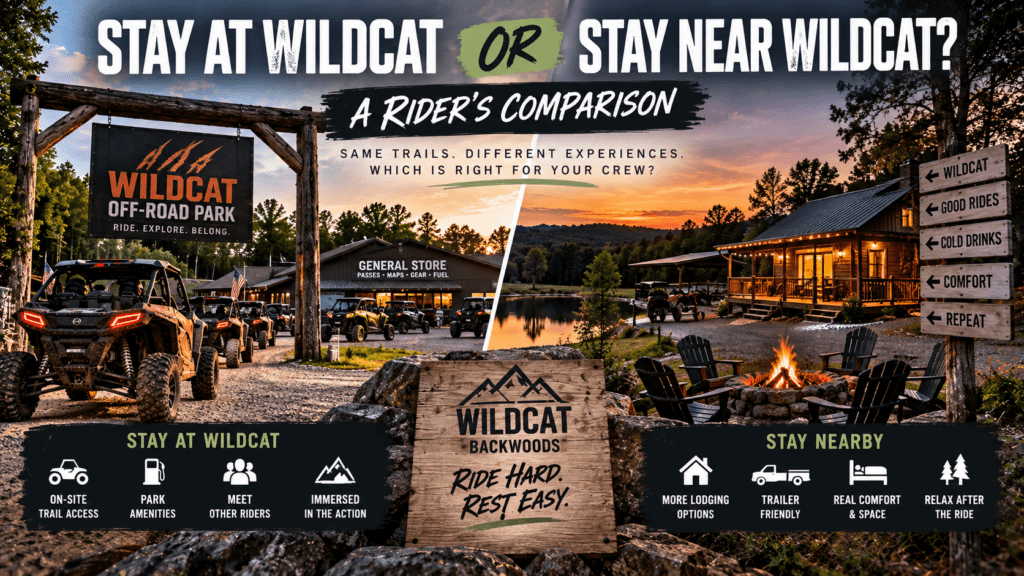
You’re planning a weekend at Wildcat Off-Road Park and you’ve reached one of the biggest decisions of the trip:
Should we stay at Wildcat—or book a cabin or vacation rental nearby?
There isn’t one answer that’s right for every riding group.
Staying at the park puts you right where the action is and can make trail access extremely convenient.
Staying nearby can give your group more choices in sleeping arrangements, parking, kitchens, privacy, outdoor space and post-ride comfort.
The mistake is deciding based on distance alone.
For a UTV, ATV, Jeep or off-road group, lodging is part of the riding logistics.
You’re bringing people.
Machines.
Trucks.
Trailers.
Coolers.
Helmets.
Boots.
Tools.
Food.
And probably considerably more stuff than you originally planned.
So let’s compare the two choices from a rider’s perspective.
The Quick Answer
Stay at Wildcat Off-Road Park if: being directly at the riding destination is your highest priority and the available accommodations fit your group, machines and preferred style of trip.
Stay nearby if: your group places more value on a particular combination of trailer parking, real beds, bathrooms, kitchen space, privacy, laundry, outdoor gathering areas or a quieter place to recover after riding.
Neither is automatically better.
The best choice is the one that creates the least friction for your particular group.
1. Trail Access: Staying at Wildcat Has an Obvious Advantage
Let’s start with the strongest argument for staying at the park.
You’re already there.
Wildcat Off-Road Park offers on-site lodging options including cabins, RV sites and primitive camping.
For riders who want to wake up immersed in the off-road experience, that’s a legitimate advantage.
Less transition between lodging and the riding destination can make mornings simple.
And when you’re finished riding, you’re already back where you’re staying.
For some groups, that’s exactly the experience they want.
Don’t dismiss that benefit just because you’re considering a cabin elsewhere.
Instead, ask:
How important is immediate park access compared with everything else our group needs?
2. But “Nearby” May Be Closer Than You Think
Staying somewhere other than the park doesn’t necessarily mean commuting from far away.
There are lodging options throughout the East Bernstadt and London area, and some are only minutes from riding access.
This is where you need to investigate what “near Wildcat” actually means.
Don’t look only at distance to the main entrance.
Ask where the property is located relative to the riding your group intends to do.
Here’s a real example.
Wildcat Pondside Basecamp is approximately:
4.1 miles from Wildcat’s main entrance
2.8 miles from Wildcat’s Hazel Patch Trail access
and approximately
700 feet from an Outlaw trail entrance
Same lodging.
Three very different measurements of proximity.
That’s why a simple statement like “4 miles from Wildcat” doesn’t tell you everything about a riding location.
3. Trailer Parking Can Matter More Than Bedroom Count
Here’s one of the biggest differences between booking lodging for an ordinary vacation and booking lodging for a riding trip.
You aren’t arriving in one SUV with four suitcases.
Your group might arrive with:
Two pickup trucks.
A dually.
Two 20-foot trailers.
Four SxSs.
Eight riders.
Coolers.
Tools.
And enough gear to invade a small country.
Before booking anything—at the park or nearby—figure out the entire parking situation.
Ask:
Can our trucks and trailers fit?
Can we unload safely?
Is there room to turn around?
Will we need to back a long trailer into a difficult area?
Can trailers remain attached to trucks?
Where do the machines park overnight?
Is the parking surface suitable after rain?
Don’t accept “plenty of parking” as enough information.
If you’re hauling a long trailer, ask specifically about trailers.
Better yet, ask for a photo.
4. Count Real Beds, Not the Maximum Guest Number
This is one of the easiest lodging mistakes to make.
A property says:
Sleeps 8.
Great.
How?
That might mean four queen beds.
Or two queens, a bunk bed, sleeper sofa and air mattress.
Those are very different arrangements for eight adults who’ve spent all day getting beaten around on off-road trails.
Open the sleeping-arrangement section and actually count:
Queen beds.
King beds.
Twins.
Bunks.
Sleeper sofas.
Futons.
Air mattresses.
Then assign your group to them mentally.
If you’re already arguing over who gets the couch before you’ve booked the place, keep looking.
5. Bathrooms Become Important Fast
One bathroom might work perfectly for a couple.
It feels considerably different when eight muddy riders return at approximately the same time.
For larger groups, bathroom count can affect the entire evening.
Everyone wants to:
Shower.
Change.
Get ready for dinner.
Clean up.
Use the bathroom.
Then do it again the next morning before riding.
When comparing staying at Wildcat with a nearby rental, look at bathrooms relative to your actual group size.
It’s not a glamorous amenity.
It’s an extremely practical one.
6. Ask What Happens to All the Riding Gear
Imagine eight riders returning.
Now picture:
Eight helmets.
Eight pairs of boots.
Jackets.
Gloves.
Bags.
Wet clothes.
Possibly muddy clothes.
Coolers.
Tools.
Random gear that somehow multiplies throughout the weekend.
Where does it all go?
This is something almost nobody thinks about when looking at pretty lodging photos.
Rider-friendly accommodations should have some combination of:
Hooks.
Shelving.
Boot trays.
Laundry.
Entry space.
Gear storage.
Covered areas.
Places where dirty equipment can exist without taking over the entire living space.
Whether you’re staying at the park or nearby, think about where your gear lives when you’re not wearing it.
7. Laundry Is More Valuable on a Riding Trip Than a Normal Vacation
A washer and dryer may barely register when you’re booking a typical weekend getaway.
For a two- or three-day riding trip, it’s different.
Saturday’s riding clothes might be:
Wet.
Muddy.
Sweaty.
Or all three.
Having laundry means those clothes don’t necessarily have to stay in a garbage bag until you get home.
It can also help with towels, socks and other gear between riding days.
If you’re comparing two otherwise similar lodging options, laundry can be a surprisingly meaningful rider amenity.
8. Think About How Your Group Eats
There are groups that want to eat every meal out.
There are groups that would rather cook everything.
And there are groups that say they’ll cook, then order pizza.
Know your crew.
If you’re staying somewhere with a full kitchen, ask whether it’s actually equipped to feed your group.
For a riding weekend, useful kitchen equipment might include:
Coffee equipment.
Pots and pans.
Good knives.
Cutting boards.
Toaster.
Crockpot or slow cooker.
Grill.
Cooking utensils.
Food-storage supplies.
A dining table large enough for the group.
That table may end up serving three purposes:
Breakfast table → trail-planning table → card table.
A kitchen isn’t automatically better than simpler lodging.
It’s better if your group will use it.
9. Consider Your Friday Arrival
Everybody thinks about Saturday’s ride.
Think about Friday at 8:30 PM.
You’ve driven several hours.
Someone arrived early.
Someone arrived late.
It’s dark.
Everybody is hungry.
Machines need unloaded.
People need to know where they’re sleeping.
Trailers need somewhere to go.
This is where easy parking and easy check-in become much more important than they looked on the booking page.
Ask yourself:
Which lodging choice makes our actual arrival easier?
For some groups, staying directly at Wildcat may win.
For others, a nearby property with easy trailer access and self check-in may be considerably simpler.
10. Consider Saturday Morning
Now flip the situation.
Everybody wakes up.
Coffee starts.
People eat.
Coolers get loaded.
Boots go on.
Helmets disappear despite being exactly where someone left them.
Someone needs air in a tire.
Someone needs to find gloves.
Then everybody wants to ride.
This is where organization matters.
The best basecamp is the one that makes the transition from:
sleeping → eating → gearing up → riding
easy.
That’s much more important than whether the cabin has fashionable countertops.
11. The Biggest Difference May Happen AFTER the Ride
This is where nearby lodging can become especially attractive for some groups.
After hours on the trail, you’re not necessarily looking for more excitement.
You’re looking for:
A shower.
Dry clothes.
Food.
A comfortable chair.
Cold drinks.
A fire.
Maybe fishing.
Maybe a hot tub.
Maybe a television.
Maybe just somewhere quiet enough to sit down and talk.
The riding day might last eight hours.
You still have an entire evening.
Ask:
What does our group actually want to do from the time we stop riding until the time we go to sleep?
That answer should influence where you stay.
12. Some Groups WANT the Park Atmosphere
This is something the old version of this article didn’t give enough credit.
Not everyone wants separation from the action.
Some riders enjoy being surrounded by machines and other riders.
They like the energy.
They like seeing what’s happening.
They like being immersed in the off-road environment for the entire weekend.
For those groups, staying at Wildcat may be part of the attraction rather than a disadvantage.
That’s why I wouldn’t automatically describe staying away from the park as better.
It’s a different experience.
Choose the one your crew wants.
13. Other Groups Want a Reset Button
After riding all day, some groups want the opposite.
Helmets off.
Machines parked.
Shower.
Dinner.
Fire.
Quiet.
That separation between ride time and recovery time can make a nearby private property attractive.
You still spend the day riding.
But when you return, the environment changes.
For families, couples and adult groups who value downtime, that can become one of the best parts of the weekend.
14. Privacy Matters More for Some Trips Than Others
Consider why you’re going.
A group of friends taking an annual riding trip may want a private place to hang out together.
A family might value having its own outdoor area.
A club may want enough space to gather without worrying about bothering neighboring guests.
Other riders couldn’t care less.
Again, there’s no universal winner.
But don’t discover after booking that the “private cabin” is one of several accommodations packed closely together if privacy matters to your group.
Look at aerial photos.
Read the description.
Ask questions.
Understand what you’re booking.
15. Machine Washing Can Be a Real Rider Amenity
If you’ve spent the day in Kentucky mud, being able to rinse the machine before loading it can be useful.
Not every property allows machine washing.
Not every property has a hose.
And a hose doesn’t automatically mean there’s a suitable place for muddy runoff.
If washing your SxS matters, ask specifically:
Is machine washing allowed?
Is there a designated area?
Is there a hose?
Is there adequate water pressure?
Some rider-focused properties go farther with dedicated wash areas or pressure washers.
That’s an amenity you probably won’t care about until your machine is completely covered.
Then you’ll care a lot.
16. Covered Machine Parking Is Different From Vehicle Parking
Another detail worth checking.
“Parking available” doesn’t tell you whether your machines have anywhere covered to sit.
Covered SxS parking isn’t necessary for every group.
But it can be useful for:
Rain.
Morning dew.
Gear organization.
Working around the machine.
Keeping machines together.
If a property advertises covered parking, confirm what actually fits under it.
17. A Hot Tub Is Great—but Don’t Let It Distract From the Basics
Hot tubs photograph extremely well.
And after a long riding day, plenty of people love them.
But I wouldn’t choose lodging because of a hot tub while ignoring:
Bad trailer parking.
Uncomfortable sleeping arrangements.
Too few bathrooms.
No gear space.
A poorly equipped kitchen.
Or difficult check-in.
Think of premium amenities as the bonus.
Get the fundamentals right first.
Parking → beds → bathrooms → rider logistics → comfort → extras.
That’s a better order for evaluating off-road lodging.
18. The Cheapest Nightly Rate May Not Be the Cheapest Trip
Suppose one option is cheaper but your group needs multiple rooms.
Or you eat every meal out because there’s no useful kitchen.
Or trucks and trailers need additional arrangements.
Or part of the group stays somewhere else.
Now compare the total cost for the entire crew.
For group lodging, calculate:
Total lodging cost ÷ number of riders = cost per rider
A $500 property split among ten riders is $50 per person before taxes and fees.
Looking at the entire group cost often makes comparisons much clearer than staring at the nightly rate.
19. Check the Checkout Requirements
Nobody wants to finish Sunday morning by cleaning a vacation rental for an hour before a long drive home.
Read the checkout instructions before booking if they’re available.
At minimum, understand:
Checkout time.
What needs done before leaving.
Whether machines need loaded significantly earlier.
How that affects a possible Sunday ride.
A rider-friendly checkout should let you respect the property without turning the last morning into a work shift.
20. Read Reviews Like a Rider
Don’t just look at the star rating.
Read what guests repeatedly mention.
Look for:
Cleanliness.
Comfort.
Mattress quality.
Water pressure.
Parking.
Easy check-in.
Host responsiveness.
Kitchen equipment.
Noise.
Accuracy of the listing.
Outdoor spaces.
Then look for comments from people traveling with trucks, trailers, ATVs or SxSs.
Their experience may be more relevant to you than a review from someone who arrived in a sedan for a quiet weekend.
21. Look at the Property on a Map BEFORE Booking
Don’t rely entirely on the listing’s distance description.
Look at the location.
Understand the roads.
Understand where the park is.
Understand where the trail access you’re interested in is.
If possible, look at satellite imagery.
For riders hauling trailers, aerial imagery can sometimes tell you more than twenty interior photos.
You may be able to see:
Driveway configuration.
Parking area.
Turnaround space.
Neighboring properties.
Terrain.
Road access.
That’s useful information.
22. Ask Questions Before You Pay
If something matters to your trip and the listing doesn’t answer it, ask.
For example:
We’re bringing three trucks, two 20-foot trailers and four SxSs. Will they fit comfortably?
That’s much better than:
Is there parking?
Or:
We have eight adults. Can you confirm exactly how many standard beds there are?
Or:
Are we allowed to wash muddy SxSs at the property?
Specific questions get specific answers.
Stay at Wildcat vs. Stay Nearby: Quick Comparison
| Consideration | Stay at Wildcat | Stay Nearby |
|---|---|---|
| Immediate park access | Major advantage | Depends on property |
| Immersive riding atmosphere | Strong | Usually less |
| Cabins/RV/camping choices | Available | Vacation rentals/cabins vary |
| Trailer parking | Verify for your setup | Verify for your setup |
| Private group space | Depends on accommodation | Can be a major advantage |
| Full kitchen | Depends on accommodation | Common in whole-home rentals |
| Laundry | Verify | Often available, but verify |
| Machine washing | Verify | Some rider properties offer it |
| Post-ride amenities | Depends on accommodation | Varies widely |
| Quiet/private atmosphere | Depends on location | Often easier to find |
| Best choice for | Maximum park convenience | Groups prioritizing their own basecamp |
The important word in that table is:
Depends.
Don’t assume.
Verify.
So, Should YOU Stay at Wildcat or Nearby?
Here’s how I’d make the decision.
I’d Lean Toward Staying at Wildcat If:
You want to be directly at the riding destination.
Your preferred on-site accommodation is available.
The sleeping arrangements work.
Your trucks, trailers and machines can be accommodated.
You enjoy being immersed in the park atmosphere.
And minimizing the transition between lodging and riding matters more than having a private group basecamp.
I’d Lean Toward Staying Nearby If:
Your group wants a private place together.
You need substantial truck-and-trailer parking.
Real adult beds matter.
You want multiple bathrooms.
You plan to cook.
Laundry matters.
You want dedicated gear space.
You value outdoor gathering areas.
Or you want the evening to feel different from the riding day.
Neither list is a verdict.
It’s a way to identify what your crew actually values.
Where Wildcat Backwoods Fits
This exact decision is one of the reasons we built Wildcat Backwoods.
We aren’t trying to recreate Wildcat Off-Road Park.
Wildcat is where you go to ride.
Our job is different.
We’re building the place you come back to after you ride.
Wildcat Pondside Basecamp
Wildcat Pondside Basecamp is designed around a maximum of eight guests.
Not twelve people squeezed into every available corner.
Eight riders. Four real queen beds.
There are three bedrooms, two full bathrooms and two separate living rooms.
The full kitchen gives the group somewhere to cook.
The dining table works just as well for dinner, cards and tomorrow’s trail planning.
Speed Queen laundry means muddy riding clothes don’t necessarily ride home in a garbage bag.
Hooks, boot trays, luggage racks and storage give helmets, jackets, boots and bags somewhere to go.
Outside, there’s substantial gravel parking, covered SxS parking, a pond, catch-and-release fishing, firepit, Adirondack chairs and free firewood.
WPB is approximately 4.1 miles from Wildcat’s main entrance, 2.8 miles from Wildcat’s Hazel Patch Trail access and about 700 feet from an Outlaw trail entrance.
The idea is simple:
Ride Hard. Rest Easy.
Wildcat Rally Basecamp
Wildcat Rally Basecamp takes a different approach.
It’s designed as a private rider compound.
The separate sleeping and gathering buildings solve a problem larger groups understand immediately:
Some people want to sleep.
Other people absolutely do not.
The compound is being designed around large-group parking, covered machine parking, a dedicated machine wash area, rider facilities, outdoor gathering, firepit and hot-tub recovery.
Think:
Sleep here → Hang out here → Park here → Wash here → Hot tub here → Firepit here → Ride Wildcat.
The two Wildcat Backwoods properties aren’t trying to be the same thing.
WPB emphasizes comfortable adult rider lodging and pondside recovery.
WRB emphasizes the private group-compound experience.
Still Comparing Wildcat Lodging Options?
If your question is specifically “stay at the park or nearby?”, use this article to make that decision.
If you’re still trying to decide between camping, hotels, vacation rentals and rider-focused basecamps, our Where to Stay Near Wildcat Off-Road Park guide goes deeper into the entire lodging decision.
And if you’re organizing the whole weekend for your group, our Ultimate Wildcat Off-Road Park Trip Planning Guide covers people, machines, trailers, food, arrival, riding days and Sunday departure.
Frequently Asked Questions
Can you stay at Wildcat Off-Road Park?
Yes. Wildcat Off-Road Park offers on-site lodging options including cabins, RV sites and primitive camping. Check Wildcat’s current availability and policies directly before your trip.
Is it better to stay at Wildcat Off-Road Park or nearby?
Neither is universally better. Staying at Wildcat maximizes immediate park access and immersion in the riding environment. Staying nearby can provide more choices for private group space, kitchens, laundry, sleeping arrangements, trailer parking and post-ride amenities.
How close should I stay to Wildcat Off-Road Park?
Instead of choosing an arbitrary maximum distance, evaluate the property’s actual relationship to the riding access you plan to use. A property may have different distances to Wildcat’s main entrance and other nearby riding access.
What should UTV riders look for in lodging near Wildcat?
Prioritize trailer access and parking, real bed count, bathrooms, gear management, laundry, kitchen facilities, easy check-in and comfortable post-ride space. Then evaluate extras such as firepits, hot tubs, ponds and entertainment.
Should I stay in London or East Bernstadt for Wildcat?
That depends on whether your priority is access to restaurants and other services or proximity to the riding area. Look at the actual property location and route rather than choosing solely by city name.
Are cabins better than camping for a Wildcat trip?
That depends on your group. Riders who enjoy camping may prefer staying closer to the outdoor experience. Groups prioritizing showers, real beds, climate control, kitchens and indoor gathering space may prefer a cabin or vacation rental.
Is a hot tub worth paying more for on a riding trip?
It can be a great post-ride amenity, but it shouldn’t outweigh fundamentals such as parking, beds, bathrooms, cleanliness and group comfort. Choose the property that solves the important logistical needs first.
How do I know if a rental really has enough trailer parking?
Ask the host with your actual setup: number of trucks, number of trailers and trailer lengths. Photos or satellite imagery can also help you understand the parking layout before booking.
Make the Decision Around the Whole Weekend
Wildcat is the reason you’re coming.
Your lodging shouldn’t compete with that.
It should make the rest of the trip easier.
If staying directly at Wildcat gives your group exactly what it needs, that’s a good choice.
If driving a few minutes gets you better sleeping arrangements, easier trailer logistics, more privacy and the kind of post-ride environment your crew wants, that may be worth it.
Don’t obsess over being the closest.
Don’t obsess over having the most amenities.
Ask a much better question:
Which option makes our riding weekend easier and more enjoyable from the moment we arrive until the moment we pull the trailers home?
Answer that correctly and you’ve probably found the right place to stay.
Ride Hard. Rest Easy.
The Wildcat Rider Guide Blog
Wildcat Backwoods Crew Rewards | Earn Free Nights
Wildcat Backwoods Crew Rewards | Earn Free Nights Ride Wildcat. Earn Free Nights. Introducing Wildcat Backwoods Crew Rewards If Wildcat Off-Road Park is the kind
Wildcat Pondside Basecamp | Cabins Near Wildcat Off-Road Park
Where to Stay for a Wildcat Off-Road Park Riding Trip: Inside a Rider-Focused Cabin Wildcat Pondside Basecamp: Rider-Focused Cabins Near Wildcat Off-Road Park If you’re
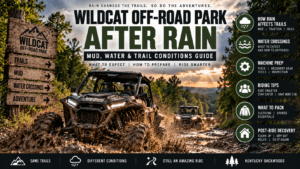
Wildcat Off-Road Park After Rain: Mud & Trail Guide
Wildcat Off-Road Park After Rain: Mud, Water & Trail Conditions Guide The forecast says rain. You’re supposed to ride Wildcat Off-Road Park this weekend. Now
Your First Trip to Wildcat Off-Road Park: Everything You Need to Know Before You Go
Your First Trip to Wildcat Off-Road Park: Everything You Need to Know Before You Go If you are planning your first trip to Wildcat Off-Road
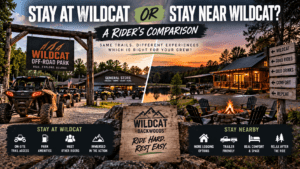
Stay at Wildcat Off-Road Park or Nearby? Rider Comparison
Should You Stay at Wildcat Off-Road Park or Nearby? A Rider’s Comparison You’re planning a weekend at Wildcat Off-Road Park and you’ve reached one of
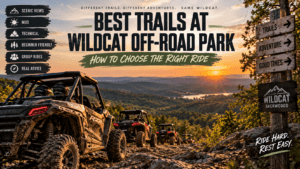
Best Trails at Wildcat Off-Road Park
Best Trails at Wildcat Off-Road Park: How to Choose the Right Ride What are the best trails at Wildcat Off-Road Park? The most useful answer
What to Pack for Wildcat Off-Road Park: UTV Checklist
What to Pack for Wildcat Off-Road Park: The UTV Rider Checklist You’re leaving for Wildcat Off-Road Park tomorrow. The machine is on the trailer. Cooler
Wildcat Off-Road Park Beginner Guide
Wildcat Off-Road Park Beginner Guide: What New Riders Should Know If you’re looking at photos and videos of Wildcat Off-Road Park and wondering “Can a