What are the best trails at Wildcat Off-Road Park?
The most useful answer isn’t a list of five trail names.
It’s:
The best Wildcat trails are the ones that match your group, your machines, current conditions and the kind of riding you came to Kentucky to do.
Wildcat Off-Road Park in East Bernstadt, Kentucky, covers approximately 2,000 acres with more than 140 miles of trails. That’s enough terrain that two groups can spend a day at Wildcat and come back describing completely different experiences.
One group may want scenery and miles.
Another wants mud.
Another wants technical terrain.
A family may want a fun day without constantly worrying about the next obstacle.
And an experienced crew may specifically be looking for something difficult.
This guide will help you figure out which kind of Wildcat ride is right for your group—and how to build a better trail day once you arrive.
Don’t Choose a Wildcat Trail From an Old Internet List
This is important.
Off-road trails aren’t paved highways.
Conditions change.
Rain changes them.
Traffic changes them.
Erosion changes them.
Mud holes change.
Water levels change.
Ruts develop.
Obstacles get easier or harder.
And the trail system itself can change over time.
That’s why we aren’t going to tell you that a particular trail is always easy, moderate or difficult based on something somebody posted online years ago.
When you arrive, get the current Wildcat trail map.
Wildcat’s General Store at 7800 N US Hwy 25 serves as the park’s primary check-in location, and Wildcat states that trail maps are available there.
Use current park information and actual trail conditions to make your decisions.
Consider this guide the strategy.
Consider the current Wildcat map the playbook.
Start by Asking: What Kind of Ride Do We Want Today?
Before choosing a route, ask the group one question:
What does everybody want out of today’s ride?
You’d be surprised how useful that conversation can be.
Maybe everyone wants to cover miles and see the park.
Maybe it’s rained and half the group came specifically for mud.
Maybe you’re introducing someone to off-roading.
Maybe the crew wants technical challenges.
Maybe yesterday was difficult and today everyone wants something more relaxed.
Don’t automatically repeat yesterday’s ride because it worked.
Build today’s ride around today’s group.
Best Wildcat Trails for First-Time Visitors
If this is your first visit to Wildcat, the best first trail isn’t necessarily the one with the biggest reputation.
Choose terrain that allows you to learn the park.
Your first few hours should help you understand:
How the trail system connects.
How current conditions feel.
How quickly your group travels.
How comfortable the least experienced rider is.
How the machines are performing.
And how accurately you’re navigating.
Start conservatively.
Once everybody is comfortable, increase the difficulty.
This approach doesn’t waste riding time.
It protects it.
A mechanical problem or overwhelmed rider at 9:30 Saturday morning can affect the entire day.
A first hour that feels slightly too easy rarely does.
If you’re new to off-road riding itself—not just new to Wildcat—our Wildcat Off-Road Park Beginner Guide covers line selection, hills, mud, water crossings and building confidence in much greater detail.
Best Wildcat Trails for Scenic Riding
Don’t make the mistake of assuming the best trail has to be the hardest trail.
Sometimes the best part of an off-road trip is simply being out there.
Scenic riding gives the group time to move, talk, stop for pictures and actually experience the Kentucky backwoods instead of spending the entire day staring at the next obstacle.
Look for routes and areas on the current map that let your group cover ground without constantly stopping for recovery.
Scenic riding can be especially good:
Early in the morning while everyone settles in.
After lunch when the group wants to keep moving.
For mixed-experience groups.
For families.
After a difficult section.
Or late in the day when everyone wants more riding without another major challenge.
Easy doesn’t automatically mean boring.
And difficult doesn’t automatically mean memorable.
Best Wildcat Trails for Beginners
Beginners should prioritize predictability over excitement.
You want terrain that allows a new driver to practice throttle control, steering, tire placement, hills and reading the trail without facing one intimidating obstacle after another.
A beginner-friendly ride should provide enough challenge to build confidence without constantly destroying it.
When using the current trail map, choose easier routes first and ask park staff about current conditions if you’re uncertain.
Recent weather matters.
Something that normally rides easily can become considerably different after heavy rain.
And remember:
The best beginner trail is the one the beginner finishes wanting to ride something slightly harder.
Not the one they barely survive and never want to see again.
Best Wildcat Trails for Mixed-Experience Groups
This may be the most common situation.
You’ve got experienced riders.
Someone who’s reasonably comfortable.
Someone who’s been riding twice.
And one person who says:
“I’ll go wherever you guys go.”
Be careful with that last sentence.
For a mixed group, build the main ride around terrain that the least experienced driver can reasonably handle, then add optional difficulty where practical.
Experienced riders don’t need extreme terrain every minute to enjoy themselves.
They can work on cleaner lines, explore different areas and help newer riders improve.
If the stronger riders want a significantly harder challenge, communicate before splitting the group.
Don’t accidentally drag beginners into something because everybody simply kept following the machine ahead.
Best Wildcat Trails for Technical Riding
Technical terrain changes the nature of the ride.
Mileage becomes less important.
Line selection becomes more important.
The group moves slower.
Machines work harder.
And recovery becomes more likely.
That’s not a bad thing.
For many experienced riders, that’s exactly the point.
But choose technical terrain intentionally.
Before committing the entire group, ask:
Does everybody want this?
Are the machines appropriate for it?
Do we have recovery equipment?
Do we have enough daylight or riding time?
What are the current conditions?
Is there another option if someone doesn’t want to attempt an obstacle?
The best technical ride is challenging enough to be memorable without turning every hundred yards into another recovery operation.
Best Wildcat Trails for Mud
Some groups see a mud hole and immediately start looking for the deepest line.
Others immediately start looking for the bypass.
Both groups can have a great Wildcat weekend.
If mud is one of the reasons you came, recent rain may significantly influence where you want to ride.
But understand the tradeoff.
Mud slows groups down.
It increases the chance of getting stuck.
It can make mechanical inspection more difficult.
It puts additional demands on equipment.
And once the machines and riders are covered, you’re probably staying that way until you return to basecamp.
If that’s exactly the weekend you want, embrace it.
If your goal is to explore as much of Wildcat as possible, don’t let the first giant mud hole consume half the morning.
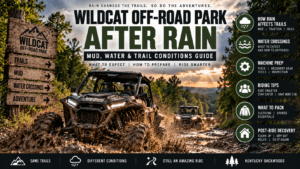
Best Wildcat Trails After Rain
This is where static “best trail” lists become particularly unreliable.
Rain can change almost everything.
Traction.
Hill climbs.
Ruts.
Mud.
Water crossings.
Rocks.
Visibility.
Even the speed at which your group can comfortably travel.
After substantial rain, approach the trail system as if some of yesterday’s assumptions may no longer apply.
Start with manageable terrain.
See what conditions actually look like.
Pay particular attention to water.
A crossing you saw in a video—or even crossed yourself on a previous trip—doesn’t come with a guaranteed depth.
Conditions win every argument.
Water Crossings: Stop Guessing and Look
Water hides the trail.
That’s what makes it different from most other obstacles.
You may not see the bottom.
You may not know how deep a rut is.
You may not see a submerged rock.
And you may not know what the current has done to the crossing since the last heavy rain.
Don’t assume that because another machine made it, yours will.
And don’t assume that because you crossed something last month, it’s identical today.
If you’re uncertain, stop somewhere safe and evaluate.
The 30 seconds you spend investigating may be the smartest 30 seconds of the ride.
How to Judge Whether a Trail Is Right for Your Group
Trail maps and difficulty information are useful.
But eventually you’re sitting in the driver’s seat looking at actual terrain.
Ask yourself:
Can I see a line?
Do you understand where you want your tires to travel?
Can everyone behind me reasonably do this?
The leader’s ability isn’t the group’s ability.
What happens if someone doesn’t make it?
Is recovery practical?
What’s beyond the obstacle?
Don’t conquer the entrance to something without considering what comes next.
Are conditions getting worse?
One difficult section may be fine. Ten increasingly difficult sections may not be.
Are we still having fun?
This question gets overlooked surprisingly often.
Don’t Judge Difficulty by the Machine Ahead of You
Watching another machine can be useful.
But make sure you’re comparing the same things.
The other driver may have years more experience.
Their machine may have different tires.
Different ground clearance.
Different suspension.
Different wheelbase.
Different modifications.
And a completely different tolerance for risk.
Watch how an experienced rider approaches the terrain.
Look at tire placement.
Look at speed.
Look at where they stop.
Learn from them.
But make your own decision.
The Trail Leader Has a Bigger Job Than Picking Directions
A good trail leader doesn’t simply know where they’re going.
They pay attention to the group.
They look behind.
They wait at intersections.
They notice when somebody is struggling.
They stop before the entire group gets committed to something questionable.
And they understand that getting ten machines through an obstacle matters more than getting their own machine through it.
If you’re leading a mixed group, your job isn’t to demonstrate what you can do.
It’s to create a good ride.
Use the “One Step Harder” Rule
This is a simple way to build a great trail day.
Start with terrain everybody can handle.
Once the group is comfortable, move one step harder.
See how it goes.
Everybody having fun?
One step harder again.
Someone struggling?
Stay where you are or back down slightly.
This is especially effective with newer riders because confidence builds progressively.
The opposite strategy—starting extremely difficult and hoping everyone figures it out—is a great way to shorten the day.
Build Your Wildcat Ride in Three Parts
Instead of trying to identify one perfect trail, think of the day in thirds.
Part 1: Learn
Start on manageable terrain.
Let everyone settle in.
Check machines.
Confirm communications.
See what conditions look like.
Learn how quickly the group moves.
Part 2: Explore
This is the heart of the ride.
Cover ground.
Find interesting terrain.
Add technical sections, scenery, mud or whatever your crew enjoys.
Stop for food and water before everybody desperately needs it.
Part 3: Finish Smart
This is where groups sometimes make bad decisions.
Everybody is tired, but someone says:
“Let’s hit one more hard section.”
Sometimes that’s great.
Sometimes that’s how a fantastic day becomes a three-hour recovery after dark.
Late in the ride, factor fatigue, fuel, machine condition and the trip back into every decision.
Finish wanting more.
How Much Trail Can You Ride in One Day?
Don’t measure a Wildcat day purely in miles.
Ten miles of difficult technical riding can consume more time and energy than considerably more mileage on flowing terrain.
Mud slows you down.
Recoveries slow you down.
Large groups slow you down.
Stops slow you down.
Beginners slow the pace—and that’s okay.
Instead of asking:
“How many miles can we ride?”
Ask:
“How much riding can we enjoy without turning the day into a race?”
Wildcat isn’t going anywhere.
You don’t need to see the entire park this weekend.
Use Saturday and Sunday Differently
If you’re visiting for a weekend, don’t treat both riding days identically.
Saturday is usually the best day for your bigger ride.
Everybody is there.
There’s more time.
The group isn’t thinking about loading trailers yet.
Use Sunday strategically.
Return to something everyone loved.
Explore an area you didn’t reach Saturday.
Take a shorter scenic ride.
Or give newer riders another chance at terrain that challenged them the day before.
Just establish a turnaround time.
Sunday’s best trail is the one that still gets you back to basecamp with enough time to load safely and leave without chaos.
Don’t Forget Wildcat’s Riding Hours
Wildcat currently states that its trail systems can be ridden until midnight.
That creates opportunities for riders who enjoy being out after dark.
But midnight is the end of riding time, not a goal for when you should start heading back.
Night changes the trail.
Depth becomes harder to judge.
Landmarks look different.
Navigation can become more difficult.
And everybody is probably more tired than they were six hours earlier.
If you’re planning to ride after dark, make sure your lights work, know where you’re going and leave yourself enough margin to return comfortably.
Get the Current Wildcat Trail Map
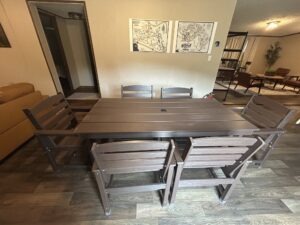

(Above are pics from our 6ft trail wall at pondside basecamp)
Before riding, stop at Wildcat’s General Store and get the current trail map.
Don’t make one person’s phone the group’s entire navigation system.
Have more than one person understand where you’re going.
If you use a GPS or off-road navigation app, download anything you need for offline use before relying on cellular service.
Digital maps can be an excellent supplement.
But when it comes to Wildcat’s current trail system, signs, park information and current trail map should take priority over an old screenshot somebody posted online.
Save the Trails You Want to Ride Again
Here’s an easy habit that makes the second Wildcat trip much better.
When your group finds something everyone loves, mark it.
Drop a waypoint if you’re using GPS.
Take a screenshot.
Write the trail information down.
Make a note in your phone.
Don’t assume you’ll remember every intersection six months later.
After a few Wildcat weekends, your group can develop its own list of favorites.
That’s much more valuable than somebody else’s generic “Top 10” list because it’s built around your crew.
Ask Other Riders—But Ask Better Questions
Instead of asking:
“What’s the best trail at Wildcat?”
Try:
“We’re four SxSs with moderate experience and want scenery plus some technical riding without extreme obstacles. What would you recommend today?”
Or:
“We’ve got two newer drivers. What’s riding well after yesterday’s rain?”
Specific questions produce useful answers.
Generic questions produce somebody else’s favorite trail—which may have absolutely nothing to do with what your group wants.
The General Store and riders who’ve been out that day can also be valuable sources of current information.
Your Best Wildcat Trail Changes as You Improve
This is part of what makes returning fun.
The terrain that intimidates you on your first trip may become comfortable later.
Something you bypassed may become something you look forward to.
You start seeing lines instead of obstacles.
You understand the machine better.
You navigate more confidently.
And eventually your definition of a “good trail” changes.
That’s why Wildcat doesn’t have to be a one-and-done destination.
Your experience of the same park can evolve as your skills do.
Plan the Trail Day Before Leaving Basecamp
Don’t wait until the machines are idling and everybody is wearing helmets to ask:
“So where are we going?”
Before leaving, take a few minutes to establish:
The general riding goal.
Who’s leading.
Who’s riding sweep.
How difficult the group wants to go.
Where you’re roughly heading.
How you’ll communicate.
What happens if someone gets separated.
Approximate return time.
And whether you’re intentionally riding after dark.
For help organizing the rest of the weekend—not just the trail route—our Ultimate Wildcat Off-Road Park Trip Planning Guide covers group organization, machines, lodging, meals, arrival and departure.
New to Wildcat?
If this is your first visit, we’ve built two resources specifically for you.
Our Wildcat Off-Road Park Beginner Guide focuses on actually driving off-road: reading terrain, choosing lines, hills, mud, water and knowing when to turn around.
Our First Trip to Wildcat Off-Road Park Guide covers the practical side of visiting: check-in, current park information, maps, group strategy and what to expect when you arrive.
Use those alongside this trail guide rather than trying to learn everything from one article.
After the Best Trail Day, You’re Going to Want a Good Basecamp
At some point, the helmets come off.
That’s when the other half of the Wildcat weekend starts.
Wet boots need somewhere to go.
Muddy clothes need dealt with.
Machines may need attention.
Everyone wants a shower.
Somebody wants food.
And eventually eight tired riders need somewhere comfortable to sleep.
That’s why we built Wildcat Backwoods around riding groups rather than ordinary travelers.
Wildcat Pondside Basecamp
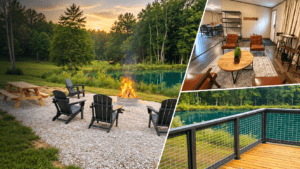
Wildcat Pondside Basecamp is designed for up to eight riders with four real queen beds, two full bathrooms and two separate living spaces.
There’s a full kitchen, Speed Queen laundry, rider gear organization and substantial gravel parking for trucks and trailers.
Outside, the experience slows down with a pond, catch-and-release fishing, firepit, Adirondack seating and room for the crew to hang out after the ride.
It’s built around a simple idea:
Ride hard during the day. Actually recover at night.
Wildcat Rally Basecamp
For larger and more social riding groups, Wildcat Rally Basecamp is being built as a private rider compound.
The separate sleeping and gathering buildings mean part of the crew can go to bed while everyone else keeps hanging out.
Large-group parking, rider facilities, machine washing, covered SxS parking, outdoor gathering areas, firepit and hot-tub recovery are all part of the plan.
The goal isn’t to fill the property with random amenities.
It’s to remove friction from the riding weekend.
Choosing Where to Stay Near Wildcat
If you’re still comparing camping, hotels, vacation rentals and rider-focused lodging, don’t choose based only on bedroom count or miles to the main entrance.
Trailer access, parking, real beds, bathrooms, laundry, kitchens and gear management can have a surprisingly large impact on the weekend.
Our Where to Stay Near Wildcat Off-Road Park guide explains what to look for before booking.
Best Trails at Wildcat Off-Road Park: Frequently Asked Questions
What are the best trails at Wildcat Off-Road Park?
The best trails depend on rider experience, machine capability, weather and what your group wants from the day. Wildcat has more than 140 miles of trails, so use the current park map and current conditions to choose terrain appropriate for your crew rather than relying solely on an old online “best trails” list.
Does Wildcat Off-Road Park have beginner trails?
Wildcat accommodates riders with different experience levels. Beginners should use the current trail map, ask about current conditions and begin on easier terrain before progressively increasing difficulty.
Where can I get a Wildcat Off-Road Park trail map?
Wildcat states that trail maps are available at its General Store at 7800 N US Hwy 25 in East Bernstadt, Kentucky.
Are Wildcat trails harder after rain?
They can be. Rain may change traction, mud, ruts, hills and water crossings. Treat difficulty as something that can change with conditions rather than a permanent characteristic.
Can you ride Wildcat Off-Road Park at night?
Wildcat’s current information says the trail systems may be ridden until midnight. If riding after dark, make sure your machines have appropriate lighting, navigation is handled and your group leaves enough time to return.
How many miles can you ride at Wildcat in a day?
It varies enormously. Technical terrain, mud, recoveries, group size, experience and stops all affect how quickly a group travels. Don’t judge the quality of a Wildcat ride purely by mileage.
What’s the best Wildcat trail for a first-time rider?
Rather than choosing a specific trail based on an old online recommendation, start with easier terrain shown on the current park map and learn current conditions. Gradually increase difficulty as the rider becomes comfortable.
So, What Is the Best Trail at Wildcat?
The one your group talks about around the fire that night.
Maybe it had an incredible view.
Maybe somebody finally climbed something they’d been nervous about.
Maybe everyone got covered in mud.
Maybe you found a perfect stretch of flowing trail and didn’t see another machine for a while.
Or maybe your favorite moment happened because somebody got stuck and the recovery became the story everyone remembers.
That’s why we wouldn’t build your Wildcat weekend around somebody else’s ranked list.
Get the current map.
Ask what’s riding well.
Understand your group.
Start smart.
Increase the challenge when it makes sense.
Mark the places you love.
And start building your own list of the best trails at Wildcat Off-Road Park.
Then come back and ride them again.
Ride Hard. Rest Easy.
Wildcat Backwoods Crew Rewards | Earn Free Nights
Wildcat Backwoods Crew Rewards | Earn Free Nights Ride Wildcat. Earn Free Nights. Introducing Wildcat Backwoods Crew Rewards If Wildcat Off-Road Park is the kind
Wildcat Pondside Basecamp | Cabins Near Wildcat Off-Road Park
Where to Stay for a Wildcat Off-Road Park Riding Trip: Inside a Rider-Focused Cabin Wildcat Pondside Basecamp: Rider-Focused Cabins Near Wildcat Off-Road Park If you’re
Wildcat Off-Road Park After Rain: Mud & Trail Guide
Wildcat Off-Road Park After Rain: Mud, Water & Trail Conditions Guide The forecast says rain. You’re supposed to ride Wildcat Off-Road Park this weekend. Now
Your First Trip to Wildcat Off-Road Park: Everything You Need to Know Before You Go
Your First Trip to Wildcat Off-Road Park: Everything You Need to Know Before You Go If you are planning your first trip to Wildcat Off-Road

Stay at Wildcat Off-Road Park or Nearby? Rider Comparison
Should You Stay at Wildcat Off-Road Park or Nearby? A Rider’s Comparison You’re planning a weekend at Wildcat Off-Road Park and you’ve reached one of
Best Trails at Wildcat Off-Road Park
Best Trails at Wildcat Off-Road Park: How to Choose the Right Ride What are the best trails at Wildcat Off-Road Park? The most useful answer
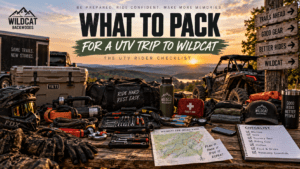
What to Pack for Wildcat Off-Road Park: UTV Checklist
What to Pack for Wildcat Off-Road Park: The UTV Rider Checklist You’re leaving for Wildcat Off-Road Park tomorrow. The machine is on the trailer. Cooler
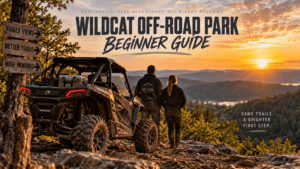
Wildcat Off-Road Park Beginner Guide
Wildcat Off-Road Park Beginner Guide: What New Riders Should Know If you’re looking at photos and videos of Wildcat Off-Road Park and wondering “Can a