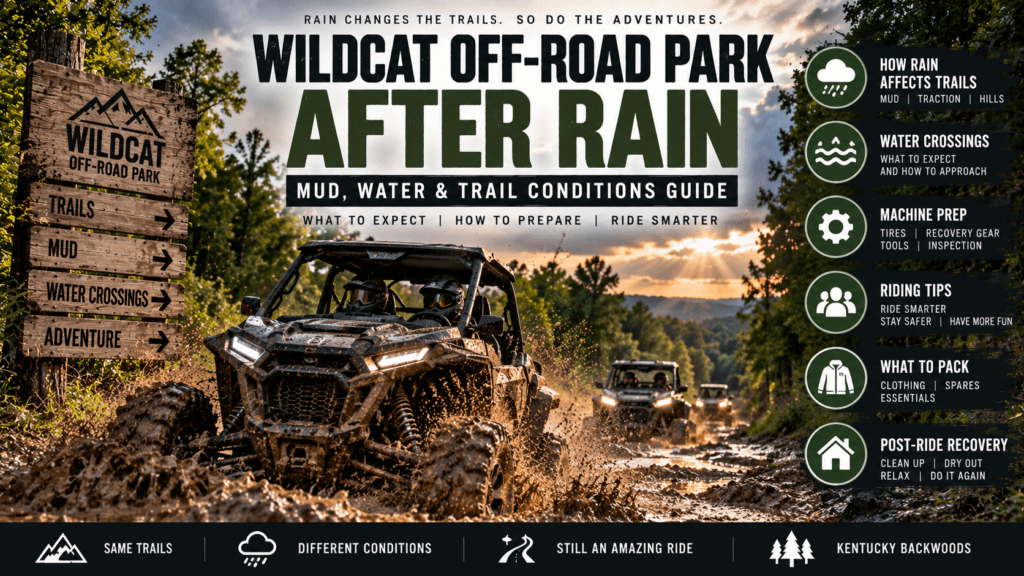
Wildcat Off-Road Park After Rain: Mud, Water & Trail Conditions Guide
The forecast says rain.
You’re supposed to ride Wildcat Off-Road Park this weekend.
Now the group chat starts:
“How bad will the trails be?”
“Does Wildcat get really muddy?”
“What about the water crossings?”
“Should we still go?”
For a lot of riders, rain doesn’t ruin a Wildcat weekend.
It just creates a different Wildcat weekend.
Mud can become deeper. Rocks can become slicker. Hills may require more careful line choice. Ruts can hold water. Water crossings can change. Trails that felt comfortable during a dry trip may require considerably more attention when they’re wet.
But wet conditions can also produce exactly the kind of riding some groups came looking for.
The key isn’t trying to avoid every puddle.
It’s understanding how rain changes the trail—and adjusting your riding accordingly.
This guide explains what riders should think about when visiting Wildcat Off-Road Park after rain, from mud and water crossings to machine preparation, clothing, recovery and choosing the right trail day.
First: Does Wildcat Off-Road Park Close When It Rains?
Don’t assume rain automatically means the park is closed.
But also don’t assume that because the park is operating, every section of trail will ride exactly as it normally does.
Weather, maintenance, temporary conditions and other factors can affect an off-road trail system.
Before leaving home, check Wildcat’s current information.
When you arrive, get the current Wildcat trail map at the General Store and ask about anything you should know before heading out.
If there has been significant recent rainfall, a simple question can be extremely useful:
“Anything out there today we should know about because of the rain?”
Current information beats something you read online from three years ago.
Every time.
How Rain Changes a Wildcat Ride
Rain doesn’t simply make a dry trail wet.
It can change how you approach the entire day.
Depending on how much rain has fallen, how recently it fell and the terrain you’re riding, you may encounter changes in:
- traction
- mud depth
- rut depth
- water levels
- exposed rocks and roots
- hill difficulty
- braking distance
- visibility
- trail speed
- recovery frequency
One of the most important things to understand is that these changes don’t happen equally everywhere.
One section may be completely manageable.
Another may hold water.
Another may become slick.
Another may be significantly more difficult than you remember.
That’s why “It rained yesterday” isn’t enough information to tell you exactly what the entire park will be like.
You have to ride the conditions you actually encounter.
Is Wildcat Off-Road Park Muddy After Rain?
It certainly can be.
Wildcat is an off-road park in southeastern Kentucky—not a paved amusement park.
Mud is part of the experience.
For some groups, that’s good news.
If everyone loaded aggressive tires, recovery gear and old riding clothes because they wanted to get muddy, recent rain may add to the fun.
But there’s an important distinction:
Wanting some mud isn’t necessarily the same as wanting an entire day dominated by mud.
Deep or repeated muddy sections can slow a group considerably.
They can increase recovery time.
Machines get dirtier.
Visibility can suffer.
Mechanical components become harder to inspect.
Riders get wetter.
And a group that normally covers a lot of ground may travel considerably fewer miles.
Decide whether mud is something your group wants to find or something you’re simply prepared to deal with.
Those are different riding plans.
The First Mud Hole Doesn’t Need to Become a Competition
You’ve probably seen this happen.
Group reaches mud.
First rider goes through.
Second rider chooses a deeper line.
Third rider decides the second rider didn’t use enough throttle.
Ten minutes later, somebody is standing ankle-deep in Kentucky mud holding a recovery strap.
Sometimes that’s exactly the fun everyone wanted.
Other times you’ve just spent 45 minutes at the first obstacle of an eight-hour ride.
Before entering a muddy section, look at it.
Where have other machines traveled?
Are there obvious ruts?
Can you tell how deep they are?
Is there a reasonable line?
Is there a bypass?
Where would you recover from if you got stuck?
And most importantly:
Does the group actually want to spend time here?
You don’t get bonus points for choosing the deepest line.
Rain Can Make Hills Feel Like Completely Different Obstacles
A hill you climbed comfortably on a dry weekend may feel very different when it’s wet.
Traction changes.
Rocks become slick.
Mud fills low spots.
Existing ruts may become more pronounced.
And spinning tires can make a poor line worse.
Don’t approach a wet hill based solely on your memory of riding it dry.
Look at what is in front of you today.
Think about:
Your tire placement.
Available traction.
Momentum.
Ruts.
Rocks.
What happens if you stop.
What happens if you don’t make the climb.
And whether there’s another route.
Controlled momentum and blindly attacking an obstacle are not the same thing.
If you’re not comfortable with the difference, our Wildcat Off-Road Park Beginner Guide goes deeper into hills, line selection, mud and knowing when to turn around.
Going Down Wet Hills Deserves Just as Much Respect
Riders tend to talk about climbing hills.
Wet descents deserve equal attention.
Gravity is already doing the work.
Now reduce available traction.
A downhill section that feels routine when dry can require considerably more control when wet.
Use the appropriate gearing and vehicle controls for your machine.
Avoid unnecessary abrupt inputs.
Look ahead.
Give the machine room.
And don’t crowd the rider in front of you.
If that rider slows or stops, you need enough space to react without creating a second problem.
Wet Rocks and Roots Can Surprise You
Mud is obvious.
A wet rock may not look nearly as dramatic.
But wet rocks and exposed roots can become surprisingly slick.
This matters particularly when they’re:
On an incline.
Off-camber.
At an angle to your tires.
Or exactly where you planned to place a tire.
Don’t assume a surface will provide traction because it looks solid.
Slow down enough to read what you’re driving over.
Smooth control becomes increasingly important as available traction decreases.
Ruts Can Hide More Than Mud
A water-filled rut creates uncertainty.
How deep is it?
Is the bottom solid?
Is there a rock hidden inside?
Does it suddenly get deeper?
Did a larger machine dig it out?
Can your machine straddle it?
Should you put a tire in it?
Should you avoid it entirely?
Don’t blindly follow the tire placement of the machine ahead.
Their width, ground clearance, tires and driver experience may be completely different from yours.
Choose a line for your machine.
Water Crossings Can Change Quickly After Rain
This deserves its own section because water is different from mud.
Water hides things.
You may not be able to see:
The bottom.
A rut.
A rock.
A ledge.
A washed-out section.
Or how quickly depth changes.
Recent rainfall can also affect water levels.
Never assume a crossing is safe because:
“We crossed it last time.”
Last time isn’t today.
And don’t assume it’s safe because the machine in front of you crossed.
Their machine may have different clearance, tires, capability or modifications.
If you’re uncertain about a water crossing, stop somewhere safe and evaluate it before committing.
Never Use an Old Video to Judge Today’s Water Depth
This is especially important for people researching Wildcat before a trip.
Videos are great for learning what the terrain may look like.
They are terrible measuring sticks for current water depth.
A video could have been recorded:
During a dry period.
After weeks without rain.
After heavy rain.
Last month.
Three years ago.
Conditions change.
Use videos for familiarity.
Use today’s conditions for today’s decision.
Rain Can Increase the Difficulty Without Changing the Trail
This is one of the most important lessons for newer riders.
A trail doesn’t have to physically change routes to become more difficult.
Reduce traction and the experience changes.
Add water and the experience changes.
Add mud and the experience changes.
Combine wet conditions with rider fatigue and the experience changes again.
So don’t become too attached to labels like:
“That’s an easy trail.”
Maybe it normally is.
Ask instead:
“How is it riding today?”
That’s a much better question.
Start Easier After Significant Rain
If Wildcat received meaningful rain before your trip, I wouldn’t make the hardest terrain your first destination Saturday morning.
Start somewhere manageable.
Give yourself time to learn what conditions are actually like.
How much mud is there?
How slick are the hills?
How much water are you seeing?
How are your tires performing?
How comfortable is the least experienced rider?
How quickly is the group traveling?
After an hour, you’ll know much more than you knew while looking at a weather app Friday night.
Then adjust.
If conditions are easier than expected, increase the difficulty.
If they’re worse, you’ve learned that before committing the entire group to something difficult.
Your Tires Matter More When Traction Gets Worse
Wet conditions have a way of making you pay attention to tires.
Before the trip, inspect:
Tread condition.
Damage.
Pressure.
And overall tire condition.
Different tires perform differently in mud, rocks and mixed terrain.
But don’t assume aggressive tires make you invincible.
No tire eliminates the need to choose a line.
And more throttle doesn’t automatically create more traction.
Sometimes it simply creates more wheelspin.
Tire Pressure Shouldn’t Be a Guess
Know the appropriate tire-pressure range for your machine, tires, load and riding situation.
Check pressure before the ride with an actual gauge.
Don’t use:
“Looks about right.”
as your measurement system.
And carry a way to deal with tire problems.
At minimum, a trail group should think about:
Tire pressure gauge.
Tire plug kit.
Inflation capability.
And the tools necessary for the machine.
Our What to Pack for a UTV Trip to Wildcat Off-Road Park guide has the complete packing checklist.
Recovery Gear Becomes More Important After Rain
The probability of using recovery equipment tends to become much more relevant when mud and slick terrain enter the equation.
Before leaving basecamp:
Test the winch.
Make sure the controller or remote is actually in the machine.
Check recovery straps.
Check connectors.
Know where your proper recovery points are.
Wear gloves when appropriate.
And make sure the people doing the recovery understand what they’re doing.
Don’t wait until a machine is buried to have the group’s first discussion about how the winch works.
A Winch Doesn’t Make Every Line a Good Idea
This is worth remembering.
Recovery equipment is there because things sometimes go wrong.
It shouldn’t become the reason you intentionally make bad decisions.
“It’s okay. We have a winch.”
is not a trail strategy.
Think about what happens if you get stuck before you enter something questionable.
Is there a suitable recovery point?
Can another machine reach you?
Will the group block the trail?
Are you creating unnecessary risk?
Sometimes the smartest recovery is the one you never have to perform.
Wet Weather Slows Groups Down
This matters when planning the day.
Suppose your group normally covers a certain amount of terrain before lunch.
After rain, you may not.
Mud takes time.
Evaluating water takes time.
Recoveries take time.
Slippery terrain can reduce speed.
Stopping to clean goggles takes time.
Changing wet gloves takes time.
Don’t turn the ride into a race because you’re behind the imaginary schedule you created while sitting at home.
Adjust the schedule.
The trail doesn’t know what time you wanted to eat lunch.
Large Groups Get Even Slower in Wet Conditions
Every obstacle multiplies with group size.
One machine crosses.
Then another.
Then another.
Then another.
If somebody gets stuck, the group stops.
If somebody needs help, the group stops.
If a beginner needs time, the group stops.
That’s okay.
Build it into expectations.
A ten-machine group after heavy rain should not expect to move like three experienced riders on a dry day.
Keep More Distance Between Machines
Wet conditions can affect stopping and control.
Give the machine ahead of you room.
This is particularly important:
On hills.
On descents.
Around muddy sections.
Near water.
And when approaching obstacles.
The machine ahead may suddenly stop because the driver sees something you can’t see yet.
You need room to react.
Visibility Can Become Part of the Problem
Rain itself affects visibility.
Then add:
Mud.
Water spray.
Fogging.
Dirty windshields.
Dirty goggles.
Dark woods.
And potentially night riding.
Bring what you need to keep your vision clear.
Depending on your setup, that might include:
Clean eye protection.
Microfiber cloths.
Appropriate cleaner.
Anti-fog strategy.
Extra goggles.
Or simply stopping occasionally to clean everything.
Being able to see is a fairly useful off-road modification.
Pack for Being Wet Even If It’s Not Raining While You Ride
This catches people.
It rained overnight.
Saturday is beautiful.
So everyone dresses for dry weather.
Then the first several miles soak boots and pants with water and mud thrown from the trail.
Wet trails can keep riders wet long after the rain stops.
Consider packing:
Extra socks.
Extra gloves.
Rain shell.
Change of riding clothes.
Dry shoes.
Dry clothes for basecamp.
And somewhere to put the wet stuff.
Few things improve an evening faster than getting out of wet riding clothes.
Bring More Gloves
This deserved its own line in our packing guide and deserves another mention here.
Wet gloves get miserable.
Muddy gloves get worse.
Recovery can soak them.
Carry another pair.
They’re small.
They’re inexpensive compared with most off-road equipment.
And you’ll be extremely happy you have them if your first pair is soaked before lunch.
Don’t Forget Food and Water Because It’s Cool Outside
Wet weather can make riders underestimate hydration.
You still need water.
You’re still concentrating.
You’re still physically working.
And if you’re recovering machines, climbing in and out or dealing with mud, you may be working harder than on a dry trail.
Carry water and food.
A ride that unexpectedly takes two hours longer is much less annoying when everybody has something to drink and eat.
Check the Machine During the Day
Mud can hide things.
Take a look at the machine when you stop.
You don’t need to perform a full service on the trail.
Just pay attention.
Look for anything obviously:
Loose.
Damaged.
Leaking.
Packed with debris.
Or behaving differently than it was earlier.
Listen too.
A new noise deserves attention.
“It’ll probably be fine” becomes less convincing the farther you get from basecamp.
Check the Machine Again When You Get Back
Don’t park a mud-covered machine Saturday night and completely forget about it until everyone is geared up Sunday morning.
Give it a quick inspection when you return.
Look at:
Tires.
Suspension.
Visible components.
Leaks.
Loose items.
Damage.
Anything you noticed during the ride.
If the machine needs to be rinsed before you can inspect something properly, handle it while there’s still time to deal with a problem.
Sunday morning is much nicer when you’re not discovering Saturday’s damage at departure time.
Mud Makes Machine Washing More Valuable
You don’t have to detail the SxS after every ride.
But there’s a difference between detailing a machine and removing enough mud to inspect it, work on it or load it without taking half of Kentucky home with you.
After a wet Wildcat weekend, access to an appropriate machine-wash area can be genuinely useful.
If you’re booking lodging and washing matters to your group, ask:
Is machine washing allowed?
Is there a designated area?
Is there a hose?
Is there adequate water pressure?
Is runoff handled appropriately?
Don’t assume every vacation rental wants four mud-covered SxSs being pressure-washed in the driveway.
Ask first.
Wet Riding Gear Needs Somewhere to Go
Now imagine eight riders returning from a wet day.
Eight helmets.
Eight pairs of boots.
Wet jackets.
Muddy pants.
Gloves.
Bags.
Towels.
This is when lodging designed around ordinary tourists and lodging designed around riders can start to feel different.
You want:
Hooks.
Boot trays.
Shelving.
Laundry.
Places to hang things.
A sensible entry area.
Somewhere for gear to dry without consuming the entire house.
Gear organization isn’t glamorous.
Until eight people need it at once.
Then it’s one of the best amenities in the building.
Laundry Can Save Day Two
A washer and dryer become much more valuable when Saturday is wet and Sunday is another riding day.
Instead of choosing between:
Wear wet/dirty gear again
or
Pack twice as much clothing
you may be able to wash and dry what you need.
That’s one reason laundry should be viewed as a rider amenity rather than simply a household appliance.
And after the final ride, washing muddy riding clothes before leaving means they don’t necessarily spend the trip home sealed in a trash bag.
A Boot Dryer Suddenly Makes Perfect Sense
A boot dryer isn’t particularly exciting in a vacation-rental listing.
Then you spend eight hours riding wet trails.
Now it makes sense.
Wet boots Saturday night can still be wet Sunday morning.
Anything that helps dry boots and gloves improves the next riding day.
This is exactly the type of small amenity riders may appreciate more than an expensive decorative feature.
Plan Saturday Night Before You Leave Saturday Morning
Wet rides can be more tiring.
So make the evening easy.
Know what dinner is.
If you’re cooking at basecamp, consider something you can prepare before leaving.
A crockpot meal is almost perfect for this.
Start it.
Ride.
Get muddy.
Come back.
Shower.
Put on dry clothes.
Eat.
Nobody needs to make a complicated dinner decision while standing in wet socks.
Don’t Let the Weather App Control the Entire Weekend
Weather forecasts are important.
Use them.
But understand their limits.
A forecast tells you what the atmosphere may do.
It doesn’t tell you exactly what every mile of trail will look like.
Likewise, seeing rain in the forecast doesn’t automatically tell you whether your group should cancel.
Look at:
How much rain is expected.
When it’s expected.
How experienced your group is.
What kind of riding you enjoy.
How prepared your machines are.
Whether you’re equipped for wet conditions.
And what current information is available.
For some groups:
Rain = problem.
For other groups:
Rain = finally, some mud.
Know which group you are.
What About Riding While It’s Actively Raining?
Active rain adds another layer.
Visibility may decrease.
Goggles and windshields get harder to keep clear.
Traction can continue changing.
Water may continue accumulating.
Temperatures can feel different.
Gear gets wet faster.
If conditions become uncomfortable or exceed the group’s experience, adjust.
There’s no award for refusing to change the plan.
The purpose of the weekend is to enjoy riding.
Not to prove you’re tougher than precipitation.
What About Riding After Several Days of Rain?
The more prolonged or significant the rainfall, the more conservative I’d be about assuming conditions based on previous visits.
Water may remain elevated.
Ground may remain saturated.
Mud may be deeper.
Ruts may hold substantially more water.
Some terrain may take time to drain.
Again, get current information when you arrive.
Start manageable.
Evaluate.
Then decide how aggressively you want to ride.
Should Beginners Ride Wildcat After Rain?
Beginners can still have a great Wildcat trip in wet conditions.
But the group needs to account for the fact that reduced traction can make familiar obstacles feel different.
I’d be even more deliberate about:
Starting easy.
Keeping the beginner near an experienced leader.
Leaving space between machines.
Stopping before questionable obstacles.
Walking something when necessary.
Using bypasses.
Taking breaks.
And turning around when something isn’t appropriate.
Don’t use a wet weekend to pressure a new rider into proving themselves.
Use it to teach them how conditions affect terrain.
That’s a much more valuable skill.
What If You Don’t Like Mud?
Here’s the good news:
You don’t have to intentionally drive through the deepest mud hole you can find just because you own a SxS.
Your riding weekend belongs to you.
If your group prefers scenery, exploring and moderate terrain, build the ride around that objective.
Ask about current conditions.
Use the current trail map.
Choose lines carefully.
Use bypasses when appropriate.
And understand that after significant rain you may still encounter wet terrain.
You don’t have to make mud the entire personality of the trip.
What If You LOVE Mud?
Then prepare for it.
That’s the difference.
Bring appropriate recovery equipment.
Inspect the machine.
Expect the group to move more slowly.
Bring dry clothing.
Bring extra gloves.
Protect phones and anything that needs to stay dry.
Have a plan for the machine afterward.
Have a plan for your gear afterward.
And make sure the other riders actually want the same kind of day.
Nothing wrong with spending Saturday getting completely covered in mud.
Just don’t surprise the person who thought everyone was going on a scenic ride.
Use Current Information Instead of Asking “Is Wildcat Muddy?”
That’s actually a difficult question to answer well.
A better question is:
“How much rain has Wildcat had recently, and how are the trails riding today?”
Or:
“We’re bringing a mixed-experience group. Are there any areas we should be cautious about after the rain?”
Or:
“How are the water crossings today?”
Specific questions produce useful answers.
“Is it muddy?”
Well…
It’s an off-road park in Kentucky.
There’s a decent chance you’ll find some.
A Better Wet-Weather Trail Strategy
Here’s a simple approach for a Wildcat trip after rain.
Step 1: Check Before Leaving Home
Look at the recent and upcoming weather.
Check Wildcat’s current information.
Don’t make your entire decision from a single weather icon.
Step 2: Ask When You Arrive
Get the current trail map.
Ask if there are wet-weather issues riders should know about.
Step 3: Start Conservatively
Use the first part of the ride to evaluate actual conditions.
Step 4: Watch the Least Experienced Rider
If they’re struggling, don’t increase difficulty because everyone else is comfortable.
Step 5: Adjust the Route
The route is a plan.
It isn’t a contract.
Step 6: Allow More Time
Wet conditions may reduce how much ground you cover.
Step 7: Finish Smart
Fatigue plus darkness plus wet terrain isn’t the ideal time to start proving things.
Come back with enough energy to enjoy the rest of the evening.
What to Pack for Wildcat After Rain
If wet conditions are likely, I’d add extra emphasis to:
☐ Extra socks
☐ Extra gloves
☐ Rain shell
☐ Dry shoes
☐ Change of clothes
☐ Appropriate eye protection
☐ Microfiber cloths
☐ Waterproof storage for sensitive items
☐ Tire plug kit
☐ Tire inflator
☐ Recovery equipment
☐ Working winch and controller
☐ Flashlight/headlamp
☐ Food
☐ Plenty of water
☐ Bags or containers for wet gear
For the complete list, use our What to Pack for a UTV Trip to Wildcat Off-Road Park checklist.
Where to Stay Becomes More Important on a Wet Weekend
On a perfect dry weekend, almost anywhere with a bed may sound acceptable.
After a long wet riding day, the differences become much more noticeable.
Can you get everyone showered?
Where do eight pairs of wet boots go?
Can you wash riding clothes?
Can you dry gloves?
Can you rinse the machines?
Can everyone get inside and comfortable?
Can you cook dinner?
Can you spread out?
Does everyone have a real bed?
If you’re comparing camping, hotels, cabins and rider-focused lodging, our Where to Stay Near Wildcat Off-Road Park guide explains what to consider before booking.
How Wildcat Pondside Basecamp Handles a Wet Riding Weekend
This is exactly where some of the less glamorous features at Wildcat Pondside Basecamp start earning their keep.
WPB is designed for up to eight riders with four real queen beds.
There are two full bathrooms, so eight muddy people aren’t depending on one shower.
Speed Queen laundry gives riding clothes somewhere to go besides a garbage bag.
Boot trays, hooks, luggage racks and gear organization give wet equipment a place instead of spreading it throughout the house.
There’s a PEET boot and glove dryer for exactly the kind of weekend we’re talking about.
And the full kitchen means the group can come back, clean up and eat without necessarily getting back into the vehicles.
After everyone is dry, there’s the second living room with the 75-inch TV—or, if the weather clears, the pondside firepit and Adirondack chairs.
WPB isn’t intended to prevent you from getting muddy.
It’s intended to make getting un-muddy afterward considerably easier.
And Wildcat Rally Basecamp Takes It Further
Wildcat Rally Basecamp is being built around the needs of larger riding groups.
That includes substantial truck-and-trailer parking, covered machine parking and a dedicated SxS wash area with a wall-mounted pressure washer.
The separate sleeping and gathering buildings also mean riders can clean up and relax without the entire group having to follow the same schedule.
And yes, after spending the day bouncing around wet trails, the hot tub starts making a pretty convincing argument for itself.
That’s the idea behind Wildcat Backwoods:
Don’t just solve where riders sleep. Solve the entire riding weekend.
Wildcat Off-Road Park After Rain: Frequently Asked Questions
Is Wildcat Off-Road Park muddy after rain?
It can be. How muddy particular areas become depends on recent rainfall, drainage, traffic and terrain. Don’t assume conditions are identical across the entire trail system.
Can you ride Wildcat Off-Road Park in the rain?
Check Wildcat’s current operating information and any current notices before your visit. If riding in active rain, account for reduced visibility, changing traction, water and the experience level of your group.
Are Wildcat trails harder after rain?
Some terrain can become more challenging when wet because traction, mud, ruts and water levels may change. A section that felt easy when dry may require more careful line selection after rain.
Are Wildcat’s water crossings deeper after rain?
Water depth can change with rainfall and drainage conditions. Never rely on an old video, photo or previous trip to determine today’s depth. Evaluate the actual crossing before committing.
How long does Wildcat stay muddy after rain?
There isn’t a reliable universal number of hours or days. Different terrain drains differently, and rainfall amount, temperature, traffic and other factors affect conditions. Look for current information rather than assuming a fixed drying time.
Should beginners ride Wildcat after rain?
They can, but groups should adjust terrain selection to current conditions and the rider’s ability. Start conservatively, increase difficulty gradually and don’t pressure inexperienced riders into obstacles they aren’t comfortable attempting.
What should I bring to Wildcat after rain?
Prioritize recovery equipment, tire-repair capability, appropriate clothing, extra socks and gloves, rain protection, eye protection, water, food and dry clothing for after the ride.
Do I need a winch after rain?
A winch is useful recovery equipment for off-road riding, particularly when mud and slick conditions increase the possibility of getting stuck. If your machine has one, test it before riding and know how to use it safely.
Should I cancel my Wildcat trip because rain is forecast?
Not necessarily. Consider the amount and timing of the rain, your group’s experience, equipment and preferred style of riding. Check current Wildcat information rather than making the decision solely from a forecast several days ahead.
Rain Doesn’t Necessarily Ruin a Wildcat Weekend
Some of the weekends riders remember most aren’t the perfect sunny ones.
They’re the ones where everybody got filthy.
Where someone found out their boots weren’t nearly as waterproof as advertised.
Where a five-minute obstacle became a 30-minute story.
Where the machines came back looking completely different than when they left.
And where dry clothes, hot food and a comfortable place to sit felt really good at the end of the day.
Respect the conditions.
Don’t underestimate water.
Give wet hills the attention they deserve.
Carry recovery gear.
Take care of the least experienced rider.
Change the route when conditions tell you to.
And don’t judge the success of the day by how closely it followed the plan.
Sometimes rain changes the trip.
That doesn’t mean it ruins it.
It may just give you a better story.
Ride Hard. Rest Easy.
The Wildcat Rider Guide Blog

Wildcat Backwoods Crew Rewards | Earn Free Nights
Wildcat Backwoods Crew Rewards | Earn Free Nights Ride Wildcat. Earn Free Nights. Introducing Wildcat Backwoods Crew Rewards If Wildcat Off-Road Park is the kind
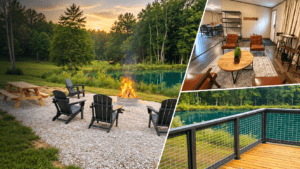
Wildcat Pondside Basecamp | Cabins Near Wildcat Off-Road Park
Where to Stay for a Wildcat Off-Road Park Riding Trip: Inside a Rider-Focused Cabin Wildcat Pondside Basecamp: Rider-Focused Cabins Near Wildcat Off-Road Park If you’re
Wildcat Off-Road Park After Rain: Mud & Trail Guide
Wildcat Off-Road Park After Rain: Mud, Water & Trail Conditions Guide The forecast says rain. You’re supposed to ride Wildcat Off-Road Park this weekend. Now
Your First Trip to Wildcat Off-Road Park: Everything You Need to Know Before You Go
Your First Trip to Wildcat Off-Road Park: Everything You Need to Know Before You Go If you are planning your first trip to Wildcat Off-Road

Stay at Wildcat Off-Road Park or Nearby? Rider Comparison
Should You Stay at Wildcat Off-Road Park or Nearby? A Rider’s Comparison You’re planning a weekend at Wildcat Off-Road Park and you’ve reached one of
Best Trails at Wildcat Off-Road Park
Best Trails at Wildcat Off-Road Park: How to Choose the Right Ride What are the best trails at Wildcat Off-Road Park? The most useful answer
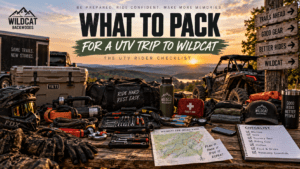
What to Pack for Wildcat Off-Road Park: UTV Checklist
What to Pack for Wildcat Off-Road Park: The UTV Rider Checklist You’re leaving for Wildcat Off-Road Park tomorrow. The machine is on the trailer. Cooler
Wildcat Off-Road Park Beginner Guide
Wildcat Off-Road Park Beginner Guide: What New Riders Should Know If you’re looking at photos and videos of Wildcat Off-Road Park and wondering “Can a